What Are Pimples (zits, spots)? What Causes Pimples?
A pimple, also known as azit or spot is a small papule or pustule; small skin lesions or inflammation of the skin – they are oil glands (sebaceous glands) that are infected with bacteria, become inflamed, and then fill up with pus.
Pimples are caused when the sebaceous glands located at the base of hair follicles become overactive; the most vulnerable parts of the body are the face, back, chest and shoulders. Pimples are palpable signs of acne, especially when a breakout occurs.
Pimples are caused when the sebaceous glands located at the base of hair follicles become overactive; the most vulnerable parts of the body are the face, back, chest and shoulders. Pimples are palpable signs of acne, especially when a breakout occurs.
According to Medilexicon’smedical dictionary:
A pimple is A papule or small pustule; usually meant to denote an inflammatory lesion of acne.
What are the sebaceous glands?
The sebaceous glands are tiny skin glands which secrete sebum – an waxy/oily substance – to lubricate the skin and hair of mammals (humans are mammals).
In human beings they exist throughout all skin sites except the palms and soles; there is a greater abundance of sebaceous glands on the face and scalp. In our eyelids, meibomian sebaceous glands secrete a special type of sebum into tears.
Several medical conditions are linked to an abnormality in sebaceous gland function, including:
- Acne (pimples).
- Sebaceous cysts - closed sacs or cysts below the surface of the skin.
- Hyperplasia - the sebaceous glands become enlarged, producing yellow, shiny bumps on the face.
- Sebaceous adenoma - a slow-growing tumor (benign, non-cancerous) usually presenting as a pink, flesh-colored, or yellow papule or nodule.
- Sebaceous gland carcinoma - an aggressive (cancerous) and uncommon skin tumor.
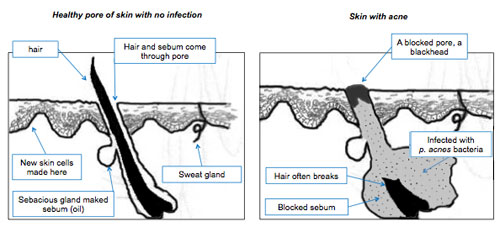
If a breakout occurs, doctors recommend that they be treated promptly to prevent the risk developing severe acne. There is also the danger that untreated severe acne may result in visible scars on the skin.
What are the causes of pimples?
The sebaceous glands, which produce sebum, exist inside the pores of our skin. The outer layers of our skin are being shed continuously.
Sometimes, dead skin cells are left behind and get stuck together by the sticky sebum, causing a blockage in the pore.
Pore blockage is more likely to occur during puberty (the process of physical changes by which a child’s body becomes an adult body capable of reproduction). More sebum is produced by the sebaceous gland – as the pore is blocked, it accumulates behind the blockage.
This accumulated and blocked sebum has bacteria, including Propionibacterium acnes; this slow-growing bacterium is linked to acne. Propionibacterium acnesgenerally exists harmlessly on our skin – however, when the conditions are right, it can reproduce more rapidly and become a problem. The bacterium feeds off the sebum and produces a substance that causes an immune response, leading to inflammation of the skin and spots.
The skin of people who are prone to acne are especially sensitive to normal blood levels of testosterone – a natural hormone found in both males and females. In such people the testosterone can make the sebaceous glands produce too much sebum, making the clogging up of dead skin cells more likely, which in turn increases the probability of blocking the pores, etc.
You cannot catch pimples from another person; they are not infectious.
There is no scientifically compelling evidence to prove that pimples are caused by diet.
Having pimples or acne can be hereditary.
Signs and symptoms of pimples – Types of pimples
- Whiteheads - also known as a closed comedo. These are very small and remain under the skin, appearing as a small, flesh-colored papules.
- Blackheads - also known as an open comedo. These are clearly visible; they are black and appear on the surface of the skin. Some people mistakenly believe they are caused by dirt, because of their color, and scrub their faces vigorously – this does not help and may irritate the skin and cause other problems.
- Papules - these are small, solid, rounded bumps that rise from the skin. The bumps are often pink.
- Pustules - these are pimples full of pus. They are clearly visible on the surface of the skin. The base is red and the pus is on the top.
- Nodules - these are morphologically similar (similar structure) to papules, but larger. They can be painful and are embedded deep in the skin.
- Cysts - these are clearly visible on the surface of the skin. They are filled with pus and are usually painful. Cysts commonly cause scars.
How common are pimples (acne)?
Acne is the most common skin disease for adolescents. According to the British Medical Journal (Clinical Evidence, Authors: Sarah Purdy, David DeBerker):
- More than 80% of teenagers get acne at some point.
- A community sample of 14 to 16 year-olds in the United Kingdom revealed that acne affected 50% of them.
- A sample study of adolescents in New Zealand found acne was present in 91% of boys and 79% of girls.
- A sample study of adolescents in Portugal found that the average prevalence of acne (in both sexes) was 82%.
- 30% of teenagers with acne required medical treatment because of its severity.
- General practitioners (GPs, primary care physicians) in the UK reported that 3.1% of 13 to 25 year-old patients visited them complaining of acne.
- The incidence of acne is similar in both adult males and females.
- Doctors report that acne appears to peak at 17 years of age.
- Acne incidence (presence, occurrence) in adults is increasing, doctors report. We don’t know why.
What Are The Treatments For Pimples? How Can I Treat My Pimples?
Self-help pimple treatments
- Washing your face about twice each day – not more often. Make sure you have a mild soap. Use warm water. Wash gently; do not scrub the skin. Experts advise the use of an OTC lotion which contains benzoyl peroxide.
- Do not pop (burst) the pimple - there is a risk you may push the infection further down, causing more serious blockage and worse swelling and redness. Popping pimples also increases the risk of scarring.
- If you need to get rid of it - if you have an important event, such as a public-speaking engagement or a wedding and it is important to get rid of a sightly pimple, get a specialist to treat it for you.
- Touching your face - even though this may require some willpower, try to refrain from touching your face with your hands. If you are using a telephone, do not let receiver touch the skin of your face – it may have skin residue or sebum on it. Before touching your face make sure you always wash your hands with soap.
- Hand hygiene - keep your hands and nails as clean as you can by washing them regularly with soap. Keep your nails short.
- Glasses (spectacles) – glasses collect sebum and skin residue; clean them regularly.
- Loose clothing - if the pimples are on parts of your body covered by clothing, such as your back, shoulders or chest, wear loose clothing. Whenever possible, avoid wearing headbands, caps and scarves – if you have to wear them, wash them regularly. In short – allow your skin to breathe.
- Make up - make sure you have taken all your make up off when you go to sleep. Only use makeup that is nonceomedogenic or nonacnegenic - you should be able to read this on the label.
- Hair - sebum and skin collects in hair. Keep your hair clean. Try to keep your hair away from your face.
- Sun exposure - overexposure to sunlight may sometimes result in the production of more sebum. Some medications used by people with acne may make your skin more prone to sunburn.
- Shaving your face - be careful when you shave. Either use safety razors (make sure blade is sharp) or an electric shaver. Before shaving, soften the skin with warm, soapy water before applying the shaving cream – the skin is softer straight after a warm shower.
Over-the-counter (OTC) pimple treatments
The majority of OTC products for pimples/acne contain the following active ingredients:
- Resorcinol - this helps break down blackheads and/or whiteheads. It is a crystalline phenol (carbolic acid, C6H5OH) and comes from various resins. This active ingredient is also used for the treatment of dandruff, eczema andpsoriasis.
- Benzoyl Peroxide, (C6H5CO) 2O2 - this active ingredient attacks and kills bacteria and slows down the glands’ production of oil. Benzoyl works as a peeling agent, accelerating skin turnover and clearing pores, which in turn reduces the bacterial count in the affected area.
- Salicylic Acid, C6H4 (OH)COOH – helps break down blackheads and whiteheads, also slows down the shedding of cells which line the follicles of the oil glands, effective in treating inflammation and swelling. Salicylic acid is a white crystalline substance which is also used as a fungicide, or in making aspirin or dyes or perfumes. It causes the epidermis to shed skin more easily, prevents pores from becoming blocked, while at the same time allowing space for new cells to grow. Many dandruff shampoos contain salicylic acid.
- Sulfur - a chemical element which is denoted with the symbol S. It helps break down blackheads and whiteheads. Sulfur, in its native form, is a yellow crystalline solid. Sulfur has been used for centuries for treating acne, psoriasis and eczema. Scientists are not sure how sulfur works to help skin diseases. We do know that elemental sulfur does oxidize slowly to sulfurous acid which is a mild reducing and antibacterial agent.
- Retin-A - helps unplug blocked pores. Retin-A contains Tretinoin, an acid form of vitamin A, also known as all-trans retinoic acid (ATRA). Tretinoin is also used for the treatment of acute promyelocytic leukemia. Retin-A has been used widely to combat aging of the skin, it also acts as a chemical peel. It was the first retinoid developed for acne use by applying it on the skin (retinoids are a class of chemical compounds that are related chemically to vitamin A).
- Azelaic Acid, HOOC(CH2)7CCOH – strengthens cells that line the follicles, stops oil eruptions, reduces bacteria growth. It is a saturated dicarboxylic acid found naturally in wheat, rye, and barley. Azelaic acid also mops up free radicals, which reduces inflammation. It is useful for patients with darker skin who have dark patches on their face (melasma), or whose acne spots leave persistent brown marks.
Most of these active ingredients may be found in medications in the form of gels, pads, creams, lotions and soaps. OTC medications will have different concentrations of these active ingredients; it is advisable to start with the lowest strengths. At first you may experience skin irritation, redness, or burning – eventually, after continued use, these side effects go away. People with sensitive skin generally go for creams or lotions.
What can make the pimples worse?
- The menstrual cycle - females with pimples often find signs and symptoms worsen one or two weeks before their period (menstrual cycle) arrives. Experts say this is most likely due to hormonal changes that occur. Some females blame chocolates – they say they consume more chocolates during the week or two prior to their period. However, there is no evidence that links chocolate consumption to pimples.
- Stress and anxiety - hormonal levels may be affected by anxiety or stress, especially levels of adrenaline and cortisol. Both these hormones are thought to make acne worse.
- Some climates - especially ones that make the individual sweat more, can cause acne to worsen. An individual who is prone to pimples may find it more difficult to cope in hot and humid climates.
- Some make ups - any make up that contains oil can make pimples worse in some susceptible individuals.
- Greasy hair - hair may become greasy as a result of using some hair products, such as those with cocoa or coconut butter.
- Bursting the pimple - the infection may be pushed down deeper. There is also a risk of scarring.

No comments:
Post a Comment